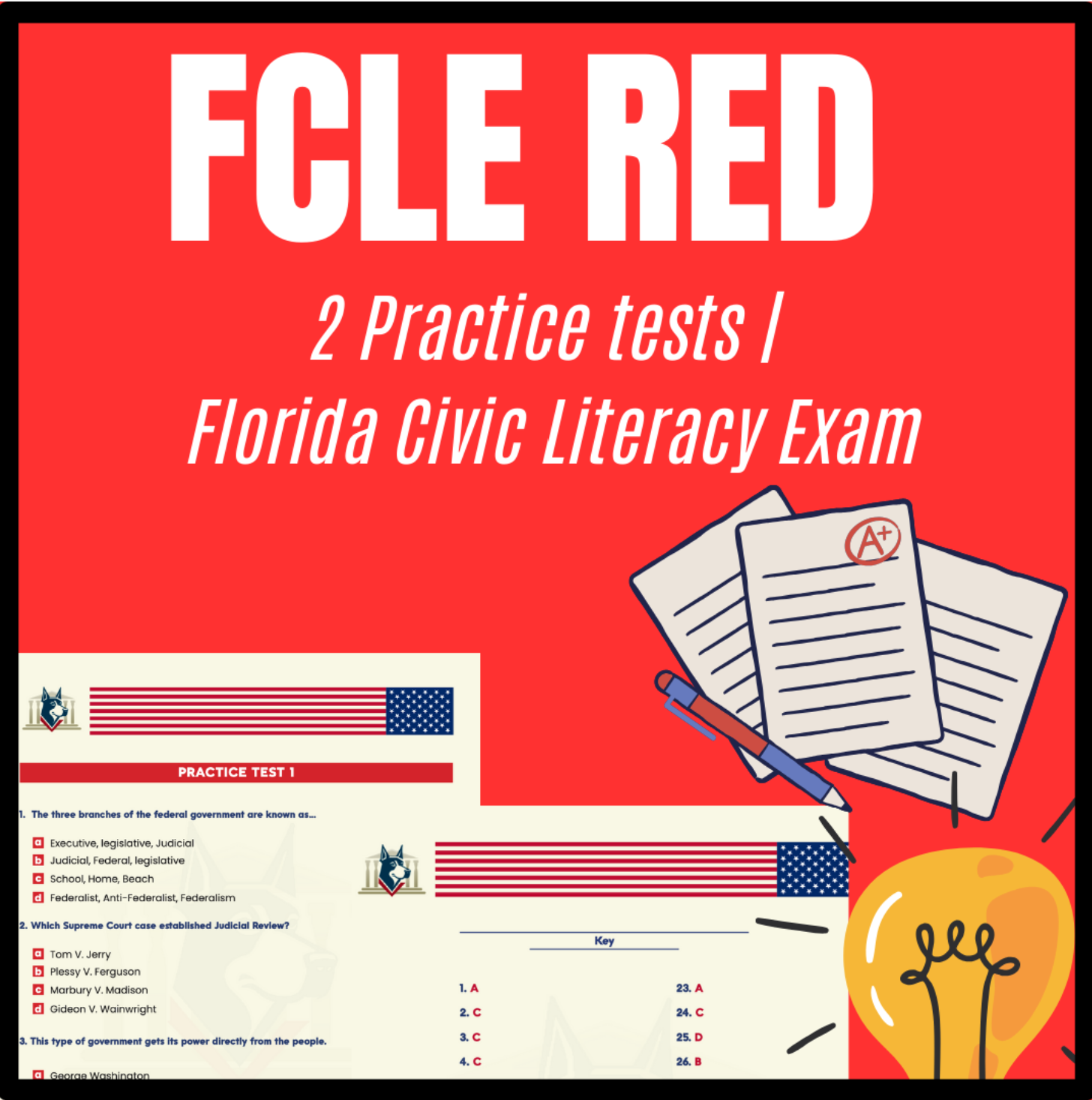
If you're preparing for the Florida Civic Literacy Exam (FCLE), you might be tempted to cram with flashcards, but this common approach can fail you. True success on the FCLE comes not from memorizing isolated facts, but from deeply understanding the principles and stories that shape our nation.
The FCLE is designed to assess your competency in American civics, a task that requires more than superficial knowledge. Rote memorization can leave you brittle and unable to answer questions that require you to apply concepts in new ways. Instead, a successful strategy involves weaving together the essential threads of U.S. government and history: constitutional principles, landmark Supreme Court cases, the ideas within founding documents, and the practical application of civic responsibilities.
This approach transforms your preparation from a tedious chore into an engaging exploration of how our government works. When you focus on the "why" behind the "what," you build a durable mental framework that allows you to analyze questions, connect ideas, and arrive at the correct answer with confidence. It’s the difference between knowing a legal precedent exists and understanding how it continues to shape American society today.
Beyond Flashcards: The Power of Constitutional Principles
The U.S. Constitution is more than just a historical text; it's the active blueprint for our government. Simply memorizing clauses or amendment numbers won't suffice for the FCLE. Instead, you need to grasp the core principles that animate the document. Concepts like separation of powers, checks and balances, federalism, and individual rights are not abstract theories—they are the mechanisms that balance, constrain, and define governmental power every single day.
For instance, instead of just memorizing that Congress has the power to declare war, understand *why* the founders gave this power to the legislative branch rather than the executive. This involves thinking about the principle of checks and balances and the desire to prevent a single person from unilaterally leading the nation into conflict. When you understand this underlying logic, you can better analyze questions about the war-making powers and the relationship between the President and Congress.
The Core Idea: Understanding principles allows you to solve problems. The FCLE tests your ability to apply concepts to situations, a skill that memorization alone cannot build.
Decoding History: Landmark Supreme Court Cases
Landmark Supreme Court cases are pivotal moments where the Constitution's principles were tested and clarified. The FCLE requires you to know about these cases, but again, understanding their context and impact is far more valuable than memorizing the year and the verdict. Each case is a story about a real conflict that forced the judicial system to interpret the nation's founding principles in a practical way.
Take *Marbury v. Madison* (1803). Memorizing the name is easy. Understanding that it established the doctrine of "judicial review" is better. But truly grasping the material means understanding how this decision fundamentally empowered the Supreme Court, giving it the final say on the constitutionality of laws and creating a critical check on the other two branches. Likewise, studying *Brown v. Board of Education* (1954) is not just about school desegregation; it’s about understanding the evolving interpretation of the "equal protection" clause of the 14th Amendment.
The Blueprint of a Nation: Engaging with Founding Documents
The FCLE also covers key founding documents like the Declaration of Independence and the Federalist Papers. Here, too, context is king. Don’t just memorize famous phrases like "life, liberty, and the pursuit of happiness." Understand the philosophical origins of these ideas, tracing them back to thinkers like John Locke, and grasp how they served as a radical justification for revolution against a monarchy.
Similarly, the Federalist Papers are not just a collection of old essays; they are a powerful and persuasive argument for why the states should ratify the new Constitution. Understanding the debates they addressed—such as fears of a tyrannical central government or the problem of factions—gives you insight into the compromises and genius of the Constitution's design. When you understand the arguments from Federalist No. 10 or No. 51, you’re not just preparing for an exam; you’re engaging with the very conversations that created the republic.
"I was just trying to memorize dates and rulings, but it wasn't clicking. Once I focused on the 'why' behind the laws and cases, everything fell into place. I felt so much more confident during the exam and passed easily!"
Our Proven Path to FCLE Success
Living Your Role: Understanding Civic Responsibilities
Finally, the FCLE connects these historical and theoretical concepts to the present by testing your knowledge of civic responsibilities. This is where your understanding becomes practical. It’s not just about knowing you *can* vote, but understanding *why* voting is a cornerstone of a representative democracy. It involves grasping the importance of jury duty as a check on governmental power and a right guaranteed to the accused. This part of the exam asks you to see yourself as an active participant in the civic life of the country, a role that is informed by all the principles, cases, and documents you’ve studied.
Active Citizenship: The goal of civic literacy isn't just to pass a test. It's to equip you with the knowledge to be an informed and engaged member of your community and country.
Pass the FCLE with Confidence
Stop cramming and start understanding. Get the expert help you need to master the Florida Civic Literacy Exam.