
You have three assignments due this week, a midterm on Thursday, and a group presentation on Friday. Sound familiar?
Most students do not fail because they are not smart enough. They fail because nobody ever taught them how to manage multiple deadlines at the same time. The good news — deadline management is a skill, and like any skill, it can be learned.
Here are 10 strategies that consistently work for students juggling heavy academic workloads.
1. Write Every Deadline Down the Moment You Hear It
The biggest mistake students make is trusting their memory. The moment a professor mentions a deadline — in class, on the syllabus, in an email — write it down immediately.
Use one central system. It does not matter whether you use Google Calendar, Notion, a physical planner, or a whiteboard on your wall. What matters is that every deadline lives in one place you check every single day.
At the start of every semester, spend 30 minutes entering every known deadline from every course into your system. This single habit alone puts you ahead of most of your classmates.
2. Work Backwards From the Due Date
Most students start thinking about an assignment the night before it is due. Top students start thinking about it the moment it is assigned.
When you get a new assignment, open your calendar and work backwards:
Due date: Friday 11:59pm
Final proofread: Thursday evening
First complete draft: Wednesday evening
Research and notes: Monday and Tuesday
Start date: This weekend
Now you have a personal deadline for each stage — and none of them are the night before submission.
3. Use the Two-Minute Rule for Small Tasks
If a task takes less than two minutes to do, do it immediately. Do not add it to your to-do list. Do not schedule it for later.
Replying to a professor's email, checking a citation format, downloading a required reading — these small tasks pile up and create invisible stress. Handle them the moment they appear.
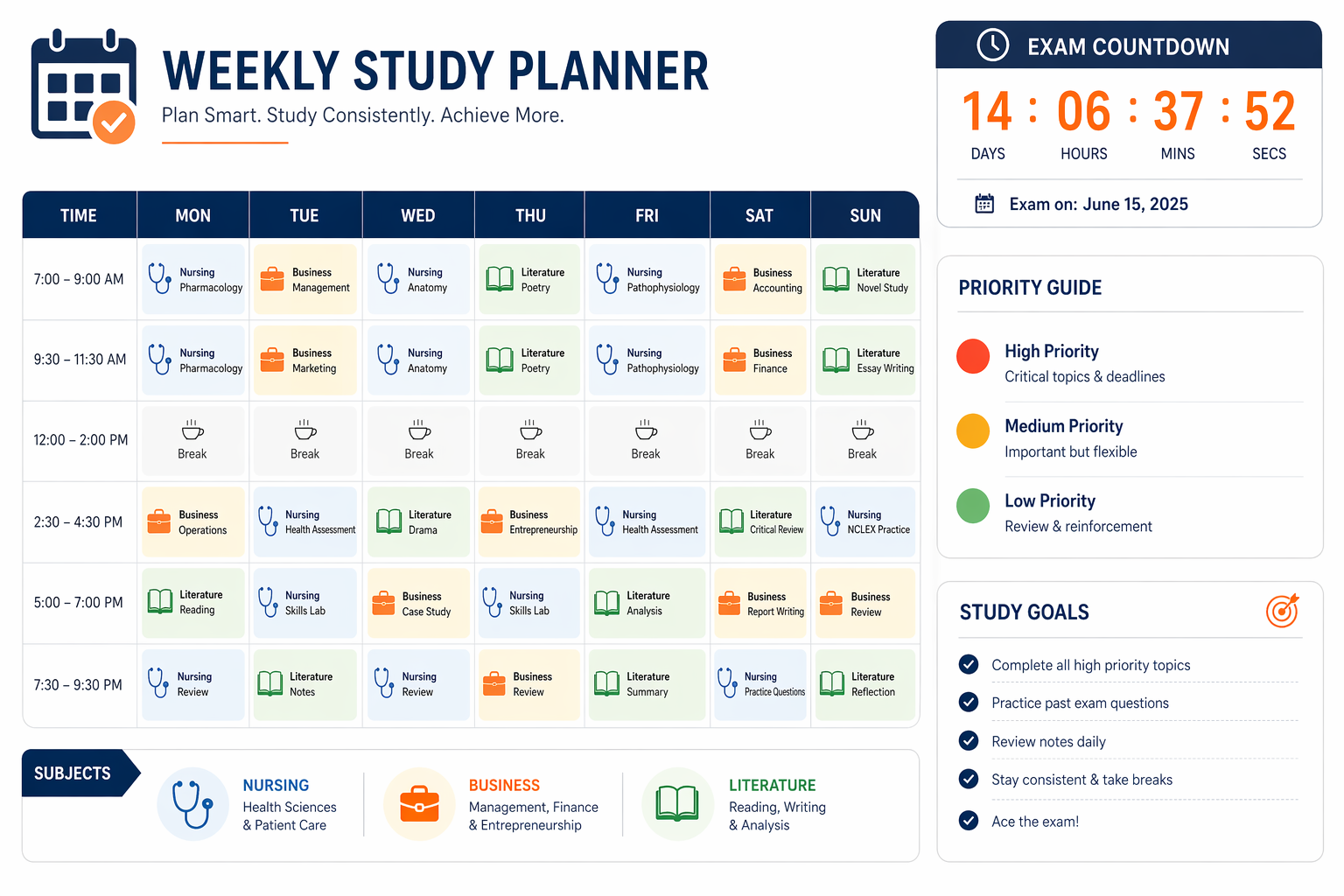
4. Time Block Your Study Sessions
Vague intentions like "I will study tonight" almost never work. Specific blocks do.
Instead of "study tonight," write: "7:00pm — 9:00pm: Write introduction and literature review for Business Ethics essay"
Time blocking works because it removes the decision of what to work on. When 7pm arrives you sit down and work on the one specific thing you scheduled. No decision fatigue, no procrastination spiral.
Keep blocks to 90 minutes maximum. After 90 minutes of focused work, take a genuine 15-minute break before continuing.
5. Prioritize by Deadline AND Weight
Not all assignments are created equal. A 500-word reflection worth 5% of your grade deserves far less time than a 3,000-word research paper worth 40%.
Every Sunday, look at your week and rank your tasks using two factors:
Urgency — how soon is it due?
Weight — how much does it count toward your grade?
High weight + close deadline = work on this first, today. Low weight + far deadline = schedule it but do not stress yet.
This prevents the common trap of spending three hours on a small task while a major assignment sits untouched.
6. The 15-Minute Start Rule
Procrastination is almost never about laziness. It is about the anxiety of starting. The blank page feels overwhelming so you avoid it.
The fix: commit to working on something for just 15 minutes. Set a timer. Tell yourself you can stop after 15 minutes if you want to.
You almost never stop after 15 minutes. Starting is the hardest part — once you are in motion, momentum carries you forward. The 15-minute start removes the psychological barrier of beginning.
7. Protect Your Deep Work Hours
Every person has 2-4 hours per day when their brain is sharpest. For most people this is in the morning. For night owls it may be late evening.
Identify your peak hours and protect them fiercely. This is when you work on your most demanding tasks — the essay that requires original thinking, the problem set that needs full concentration.
Save low-energy tasks (reading, formatting references, submitting files) for your off-peak hours.
Do not schedule social media, group chats, or Netflix during your deep work window. Those hours are too valuable.
8. Break Large Assignments Into Daily Micro-Tasks
A 4,000-word dissertation chapter feels impossible. Writing 400 words per day for 10 days feels completely manageable.
The moment you receive a large assignment, break it down into the smallest possible daily actions:
Day 1: Read the brief, identify the key question
Day 2: Find 8 sources in the library database
Day 3: Read and annotate sources, take notes
Day 4: Create a detailed outline
Day 5-7: Write 500 words per day
Day 8: Complete first draft
Day 9: Edit and revise
Day 10: Final proofread and submit
Now the assignment is not one massive task — it is 10 small, manageable actions. Tick one off per day and the work gets done without a crisis.
9. Know When to Ask for Help Early
One of the most costly mistakes students make is struggling silently until it is too late.
If you are stuck on a topic, confused by the brief, or genuinely overwhelmed by the workload — ask for help early. Talk to your professor during office hours. Visit the writing center. Work with a study group.
The longer you wait, the fewer options you have. A problem you identify two weeks before the deadline has many solutions. A problem you identify at 11pm the night before has almost none.
Professional academic support services exist precisely for moments when the workload becomes unmanageable. There is no shame in using the resources available to you — smart students use every tool at their disposal.
10. Review and Reset Every Sunday
High-performing students spend 20 minutes every Sunday doing a weekly review:
What deadlines are coming up this week?
What did I not finish last week that needs to carry forward?
What is my most important task for Monday?
Am I on track with any long-term projects?
This Sunday reset prevents the Monday morning panic of realizing something is due in two days that you forgot about. It keeps you permanently one step ahead rather than permanently one step behind.
The Bottom Line
Deadline stress is not inevitable. It is the result of a system — or the absence of one.
Pick two or three of these strategies, implement them this week, and notice the difference. You do not need to overhaul your entire life overnight. Small, consistent changes to how you plan and prioritize will compound into dramatically better results over a single semester.
And on the weeks when the workload genuinely becomes unmanageable despite your best efforts — remember that you do not have to face it alone.
Struggling with a specific assignment despite your best planning? Our verified expert writers are available 24/7 to help you meet your deadline with confidence. Place your order today and get matched with a specialist in your subject area.